Showing posts with label marketing. Show all posts

04 March 2023

Book Review: Nothing Gets Sold Until The Story Gets Told

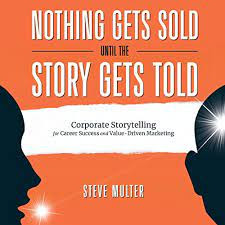
Nothing Gets Sold Until The Story Gets Told: Corporate Storytelling for Career Success and Value-Driven Marketing
by Steve Multer 
Message Master Media, 234 pages


If you’re in the marketing business, you know the difference between selling and telling.


But what if that difference isn’t what you thought?


You might think selling is what you want to do, and it requires a convincing pitch, versus telling, dismissed as just reciting facts and figures. “Show up and throw up.”


A new book turns that old wisdom around.


Selling is what you want to accomplish, but this new book says that telling – telling a story – is what closes the sale. In Nothing Get Sold Until the Story Gets Told, Steve Multer explains the role of storytelling in creating an effective message. It comes naturally for him because he tells stories for a living as a corporate presenter, spokesman, and public speaking trainer.

That’s right, a corporate presenter. It’s a perspective marketing and advertising people may not have considered, but Multer has a keen eye for all forms of marketing communication. Early in the book he describes an early form of content marketing -- from the 19th Century no less.


The Too Much Information Age


Much of the foundational thinking in the early chapters will ring true to marketers. The book describes in layman’s terms how our brains receive messages, categorizing them as no-value, low-value, medium-value, and high value. Very few messages make it to the high-value category, the ones that speak to us on a personal level first. Chapter 4 is a perspective in knowing your audience, which is the first rule of advertising. Chapters 5 and 6 are about clarifying your message. Successive chapters are about how to create and deliver the message.


This is not a trite book about public speaking, either. Multer debunks hackneyed advice like “open with a joke,” “tell a funny story,” or “shock your audience to gain their interest.” Those are tropes that don’t give your audience anything meaningful. (If we're honest, Super Bowl advertising has become a showcase for similar tropes that don’t give the audience anything meaningful.)


Passion is a word that comes up in the book frequently. That may not always be appropriate in an advertisement, but it is always appropriate in preparing an advertisement. You know how when you see a great ad, you know that the work has been loved by the people who made it? That’s passion showing through.


By the time you get to the chapter “From Corporate Speak to Human Conversation” you’ll see that this book really does apply to marketing and advertising, not just presentations. That said, we’re all presenters at some point in our work weeks. You’ll find a lot of solid advice for effective storytelling, including even how to make power point (and Zoom) work for you, not against you.


Coming back around to the title, we might agree that the best advertisements have always been the ones that tell stories. An ad that tells a story is always going to be more memorable. My two rules of effective advertising: (1) Impossible to describe the ad without mentioning the product. (2) Impossible to forget what brand created it. Stories make that possible.


Between each chapter is a short essay by someone who tells stories: an art historian, a musician, a documentarian, a playwright, a rabbi, an actor, others, and me. Yes, full disclosure, I contributed a page to this book, which naturally told a story about presenting an ad campaign to a client. Read my story here but look for Steve Multer’s book here

23 March 2021

Book Review: Working Backwards by Colin Bryar and Bill Carr

Working Backwards: Insights, Stories, and Secrets from Inside Amazon
By Colin Bryar and Bill Carr
St. Martin's Press, 304 pages


"You, too, can build a business behemoth - just like Jeff Bezos - by following the proven method of Working Backwards!"

Colin Bryar and Bill Carr don't come right out and make that promise, but their book Working Backwards openly invites you to adopt Amazon's business methods. They both left Amazon years ago, but "can't imagine doing business without (these principles)." Given their success, you can understand their enthusiasm - and perhaps your own curiosity about what made Amazon so successful.

Working Backwards: Book Summary


The first half of the book, "Being Amazonian," lists the elements of their corporate culture: leadership principles, hiring process, organizational design, prose narratives vs. PowerPoint, consumer focus, and managing inputs vs. outputs. The second half of the book tells stories of how these principles led to successful product launches: Kindle, Amazon Prime, Prime Video and AWS.


Despite how neatly the book summarizes all of the lessons, there's a real-life messiness to the narrative because Amazon admits failures on the road to success, and the authors are honest about those journeys.

This review focuses on two elements of their corporate culture, communication in prose, and the consumer focus.

Communicating: Narratives and the Six-Pager


My whole reason for reading the book in the first place was a sense of vindication about the superiority of memo-writing, especially over PowerPoint.

You may have heard that Amazon banned PowerPoint in favor of six-page memos, or "narratives" that present the meeting material in one cogent, organized document. The authors describe how the company realized PowerPoint may enable a great presentation but it rarely catalyzed insightful discussion. In a memo to employees, Bezos said "a good memo forces better thought and better understanding of what's more important than what, and how things are related." PowerPoint, he added, "gives permission to gloss over ideas, flatten out any sense of relative importance, and ignore the interconnectedness of ideas." Hear, hear!

How this works in practice: there is "an eerie silence at the beginning of Amazon meetings" while those assembled take 20 minutes to read the memo. (Don't you love the idea of not having to do the homework before showing up at the meeting?) The authors describe the company's reaction to the PowerPoint ban, and difficulty in changing to the six-page memo, but they stuck to it and now it's enshrined in this book as a principle. They even wrote, within the book, a six-page memo about how to write six-page memos.

Working Backwards: Start with the Desired Customer Experience


Every marketing thought leader, guru, Twitterati, and conference speaker has always spouted some version of the wisdom that innovation must start with the desired customer experience. In this book you can read about how to do it vs. just hearing yet another sermon about it. PR pros will delight at the idea that new product innovation at Amazon begins with the writing of a press release, a document they call PR/FAQ. This is akin to writing a new product concept for BASES forecasting, but the example they give on page 109 starts with an amazingly clear first paragraph that's better than most new product concepts I've seen in my career. Just like the six-page memo, this press release with FAQs focuses the team's thinking.

The rest of the chapter describes in Amazonian terms how they think through the market opportunity, source of volume, economics, P&L, external partners, and feasibility hurdles. You will nod your head at all of these steps, but the news here is how, having started with the customer experience in mind, they never lose sight of it amidst the numbers and analysis.

Something from an earlier chapter explains how Amazon organizes for innovation. You've probably heard of Amazon's "two-pizza rule," referring to the number of people who can be fed by two pizzas. Often described as a limit on the number of people in a meeting, it's actually the number of people allowed on a product development team. The authors explain that they tried this concept in other functional areas but it only proved necessary for speedier product development.

Yes, I recommend this book


A friend once observed that most business books can be written as 14 PowerPoint slides, i.e., most business books are not as analytical and insightful as 300 pages would suggest. That's not the case here. After one of the most serviceable book introductions I've ever read, each chapter reads quickly and clearly. All that practice writing six-page memos instead of PowerPoint decks obviously helped.

15 January 2021

Artificial Intelligence vs. Genuine Creativity


Will Artificial Intelligence replace Creativity?

No, but it might help it, in a roundabout way.

What is AI? What can it do?


Nearly all AI work today is based on successes in machine learning. Think of machine learning as having enough data and enough processing power to think through analyses that would take humans too long to do. Imagine a mountainous, time-consuming task that needed to be done, however slowly.

Here’s one example. For half a century, scientists have been mapping the three-dimensional shapes of proteins that are responsible for diseases like cancer and Covid-19. They refer to this mapping as “unfolding,” and doing it for just one protein takes a long time and a lot of money. Up to now they’ve “unfolded” only a fraction of the 200 million known proteins. The work done so far was recently fed to an AI program called “AlphaFold” which used it to do decades of work all at once. The results have been published online for review by the scientific community.

Did AI cure any diseases? No, but it advanced the work of scientists trying to do so.

Can AI advance the work of creativity?

How to approach AI


Some AI experts will tell you to approach AI with three questions in mind:

1) Is the task genuinely data driven?
2) Do you have the data needed?
3) Do you need the scale that automation provides?


On that last question: If you have a decision that needs to be made more than once per minute, then yes, you need the scale; if you have a decision that needs to be made only once per year, then probably not.

Does creativity answer “yes” to all three questions? What kind of creativity are we talking about? A painting, a sculpture, a novel? An advertisement? Let’s focus on advertising for the moment.

Advertising, Big Data and AI


We can’t say the task of creating ads is “genuinely data driven.” Sure, advertising ideas for a particular client or project may entail data or feature a data point, but even that isn’t a matter of computation. Nor is the task so routine that we create ads at a rate of more than one-per-minute. (OK, it feels that way sometimes.) Variations on an ad, however, might drive that kind of scale. Personalization of ads, for example, might be accomplished with AI that considers not only the recipient’s name but their past purchase history and other data. That’s already happening in most online marketplaces, and don’t forget that direct mail is personalized. But these are all variations on an ad created by humans.
It's a protein,
not a creative brief


There have been attempts to create at least one kind of advertising with AI: movie trailers. The first experiment was back in 2016: someone wrote a program, based on consumer reactions to movie trailers, that could lift scenes from a movie and sequence them in 30 seconds that would effectively convince people to see the movie. Judge the results for yourself and see here a more recent experiment from 2018. More recently, Netflix invested in technology to automate trailers for their content, while adding personalization for its subscribers, which makes sense for an individualized setting like your Netflix account.

Setting aside the irony that movie trailers are already quite formulaic, we see that AI made an ad. But does anyone really think that the studio marketing head won’t ask the machine for revisions? What about the movie itself? Could AI create a full-length, cinematic feature?
 
This may depend on one’s world view.

Keep AI in perspective


AI can certainly enable a human being to see new possibilities. For example, large amounts of data may help us predict future changes in consumer behavior. Knowing these possibilities may lead to a new insight on how to position a product or service. There’s great value in AI when it comes to aiding our thinking process. It can give us insight that inspires creativity. But that creativity is human, not artificial.

At an AI conference, a very intelligent professor of computer science said, “There’s no aspect of human cognition that can’t be modeled on a machine.” At the next break, I sought him out to learn more. He explained his world view that humanity – the human mind – is essentially physical, part of the physical world, and therefore can be modeled. Yes, he explained, machines will gain the ability to make cinematic features when AI develops enough to mimic every function of the brain. I asked, does it follow that humans are essentially machines? Incredibly, he said, “Yes, that’s a fair statement of how I see it.”

I see it differently. Creativity takes judgment, and human judgment comes from each person’s uniqueness, and their interaction with other people’s uniquenesses, to create something with passion and imagination. Perhaps, like me, you believe that we are more than machines. We have a spirit, a soul if you will, that animates us and gives us the ability to create sculptures, novels, choreography, and advertising. No machine can ever replicate that.

18 November 2020

What is Ad Majorem?

Thank you for visiting my blog, Ad Majorem.  When it started in the late 2000s, it was a view on modern marketing from within a large advertising agency.  Now it’s a view on modern marketing from the perspective of a CMO.

The title, Ad Majorem, is part of a familiar Latin phrase and loosely translates to English as “to the greater.”  As in, there is always an opportunity for better marketing: stronger consumer insights, more powerful ideas, channel-neutral marketing plans, and accountability so we know what sells and what doesn’t.


There’s also always an opportunity for better marketing people.  It’s important to me that team members keep learning as they go, staying curious and maintaining a perspective of continuous improvement.  We’re happier when we’re learning and growing, so that will continue to be a theme here.

The “ad” in Ad Majorem means all marketing communications, from social media to direct mail to Internet gaming to television commercials. To most consumer audiences all of these are advertising. My 
professional experience

in these channels provides a perspective that is part specialist, part generalist.

A lot has changed since 2009, not all of it “to the greater.”  We’re at a very inauspicious moment, with uncertainty, threats, deepfakes and divisions.  This blog has always avoided politics, and will continue to avoid politics, because there are too many wannabe pundits in marketing and advertising already.

That said, there’s always hope for the future, so the tone here will be hopeful as well as honest.  Don’t come here for dirt, fear or loathing. The closest I’ll come to that is self-criticism of the marketing business. Occasionally I’ll stray into a review of a campaign but only in service of a larger point.

Please comment. Otherwise this wouldn’t be an honest look at an industry where communication with consumers should be two-way, not just one-way.

One thing hasn’t changed since I started this blog.  Ad Majorem’s reason for being is to keep myself honest on embracing the challenges and changes of modern marketing. My hope is that you, too, will derive some professional growth from it.

30 April 2014

Greetings from Startup Land


Which one delivers results?

This past month on Ad Majorem I've described in a series of posts how I went from Ad Land to Startup Land.  My hope is that you found it interesting or helpful or both.

There are a lot of differences between the two worlds.  I'd argue that one big thing Startup Land can teach Ad Land is how Technology and Marketing can work together.

One big similarity?  I've seen that whether you're in Ad Land or Startup Land, the only way to create real value is to focus on delivering results.

Here's an index to the whole series.  Thanks for reading.

How I Went from Ad Land to Startup Land

Startup Land Has No Boundaries

Startup Land, Where Technology and Marketing Work Together

In Startup Land, Management Really Is Nimble

Results Also Matter in Startup Land

Book Review:  Quick and Nimble

28 April 2014

Book Review: Quick and Nimble


Quick and Nimble:  Lessons from Leading CEOs on How to Create a Culture of Innovation
By Adam Bryant
Henry Holt & Co., 264 pages

While writing the series Greetings from Startup Land, I noticed this new book by Adam Bryant, the Corner Office columnist at the New York Times, titled Quick and Nimble.  So, as a bonus extra to the Startup Land series, here’s a nimble version of the Ad Majorem Book Review.  (Slightly less nimble book reviews here, here and here.)

Bryant starts on the premise that big companies can learn from startups how to be quick and nimble.  A competing theme is that companies in general can learn from so-called innovative companies how to be more innovative.  The book doesn’t really deliver on either of these promises.  Instead, it’s a collection of Things Big Company CEOs Have Learned.  Which probably makes sense, because the source material is Bryant’s weekly profiles of Big Company CEOs Who Have Learned Things.

In fairness, much of what emerges from these interviews is a response to the generally bureaucratic nature of big companies in an era when technology has made interpersonal communication much more instantaneous.  In other words, communication has been democratized and corporations are still catching up.

So if you are currently in a leadership position, or wish to be, this book requires two hours for a speed-read, or four to six hours for more careful consideration.  Either way, you’ll probably take away a couple of techniques worth emulating.  But it won’t make your company more nimble.

23 April 2014

Results Also Matter in Startup Land


Decades ago the Ad Land pioneer Rosser Reeves asked, “What do you want from me?  Fine writing?  Or do you want to see the sales curve start moving up?”  We may argue, half a century later, as to how widely Ad Land holds that sentiment.  Startup Land depends on it – or at least depends on the sales curve rising fast enough to beat the burn rate.  

Or does it?

Years ago, Eric Schmidt described Google's business strategy as “URL” -- Ubiquity first, Revenue Later.  That worked for Google, but many venture capitalists who invest in technology seem to take it literally.  There is a lot of money poured into companies that may still be in the red for years, like Amazon, Pinterest and many others.

Dollars and Cents

Sadly, most people in Ad Land are insulated from business results until the moment when agency layoffs are unavoidable.  Agencies have been slow to embrace results and accountability.  One pundit says clients are complicit.

Last of a series
Because Startup Land is for the most part small and nimble, it’s impossible to be insulated from business results.  Everything is very out in the open.  If your company hasn’t gone public, you’re still accountable to your investors, whose money you’re spending to grow the business.  Our investors hold us accountable, and I wouldn’t have it any other way.  

Traveling in these circles, however, I am struck by how few investors really do their homework on the day-to-day operations of the companies they invest in.  Some are far more interested in financial instruments – credit facilities, warrants and the like – than in what makes the sales curve go up.  Many investors love seeing stock prices rise on the possibility of future results.  (Today's news suggests that caution is order.)

Kiss a Lot of Frogs

There’s an old saying, repeated often in Startup Land, that you have to kiss a lot of frogs before getting to the prince.  It applies both to raising capital (which we recently did) and raising the sales curve (which we are always doing).  As I’ve mentioned a couple of times in this series, it’s easy to get impatient.

Impatience may be a virtue, but don’t lose focus.  Whether you’re in Ad Land or Startup Land, focus on delivering results, not just the promise of them.  It's the only way to create real value.


15 April 2014

In Startup Land, Management Really Is Nimble


Maybe it’s just because startup companies are small by definition, but management really is nimble.  In our company, “management” is three people:  the CEO, the CTO and the CMO.

I’m still not sure if we’re nimble because we can be (there are just three of us) or if we have to be (market forces move so quickly these days).  Maybe a little bit of both.  I do know that big companies want to be nimble.  When Google founder Larry Page took over as CEO, he said he wanted “the nimbleness and soul and passion and speed of a startup.”

Interestingly, that quote lists four characteristics that form a sine qua non daisy chain of Startup Land merit badges.  You can’t have any of these without the others.  In other words, you’re not nimble if you don’t have soul or you lack passion or speed.

Dance, Startup Boy, Dance!

Happily, things in Startup Land move much faster than things at a big holding company in Ad Land.  When we took over our little company, it was clear we had to put costs in line with revenue, modify the business model and clean up the code.

Fourth of a series
Coming from Ad Land, “costs in line with revenue” is usually a synonym for “employee layoffs” but that wasn’t the case here.  As in many startups, the company was just burning through too much investor cash on things that didn’t really drive the business.  You see those things quickly when there’s no bureaucracy hiding them.

We also very decisively focused the company’s business model.  We’re winding down a legacy business in managing proprietary hardware – call it “owned media” – for institutional advertisers.  We stopped licensing software to clients, which yielded very little revenue and more than a few operational issues.

We inherited an excellent software platform, but like any such platform it needed regular updating.  The CTO started a project, working closely with Marketing, to release new versions every four to six weeks.  This allowed us to prioritize what we needed and get it to market faster, rather than waiting for One Big Release that might come months later.

Some things just can’t get done right away.  You only have so much time and talent available.  For example, we are only just now revising the website.  But we made that decision ourselves versus being held hostage to a corporate process.

Impatience Can Be a Virtue

In the first post of this series we mentioned that Startup Land requires patience, and that’s still true.  Impatience, however, drives nimbleness.  You want to make things happen quickly, so you do. 

To resolve this apparent paradox:  Be impatient with what you can control, and patient with what you can’t.  Which leads to our next post.