Showing posts with label big idea. Show all posts

04 March 2023

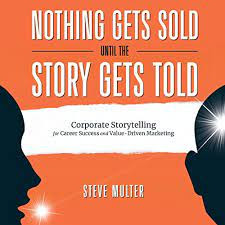
Book Review: Nothing Gets Sold Until The Story Gets Told

Nothing Gets Sold Until The Story Gets Told: Corporate Storytelling for Career Success and Value-Driven Marketing
by Steve Multer 
Message Master Media, 234 pages


If you’re in the marketing business, you know the difference between selling and telling.


But what if that difference isn’t what you thought?


You might think selling is what you want to do, and it requires a convincing pitch, versus telling, dismissed as just reciting facts and figures. “Show up and throw up.”


A new book turns that old wisdom around.


Selling is what you want to accomplish, but this new book says that telling – telling a story – is what closes the sale. In Nothing Get Sold Until the Story Gets Told, Steve Multer explains the role of storytelling in creating an effective message. It comes naturally for him because he tells stories for a living as a corporate presenter, spokesman, and public speaking trainer.

That’s right, a corporate presenter. It’s a perspective marketing and advertising people may not have considered, but Multer has a keen eye for all forms of marketing communication. Early in the book he describes an early form of content marketing -- from the 19th Century no less.


The Too Much Information Age


Much of the foundational thinking in the early chapters will ring true to marketers. The book describes in layman’s terms how our brains receive messages, categorizing them as no-value, low-value, medium-value, and high value. Very few messages make it to the high-value category, the ones that speak to us on a personal level first. Chapter 4 is a perspective in knowing your audience, which is the first rule of advertising. Chapters 5 and 6 are about clarifying your message. Successive chapters are about how to create and deliver the message.


This is not a trite book about public speaking, either. Multer debunks hackneyed advice like “open with a joke,” “tell a funny story,” or “shock your audience to gain their interest.” Those are tropes that don’t give your audience anything meaningful. (If we're honest, Super Bowl advertising has become a showcase for similar tropes that don’t give the audience anything meaningful.)


Passion is a word that comes up in the book frequently. That may not always be appropriate in an advertisement, but it is always appropriate in preparing an advertisement. You know how when you see a great ad, you know that the work has been loved by the people who made it? That’s passion showing through.


By the time you get to the chapter “From Corporate Speak to Human Conversation” you’ll see that this book really does apply to marketing and advertising, not just presentations. That said, we’re all presenters at some point in our work weeks. You’ll find a lot of solid advice for effective storytelling, including even how to make power point (and Zoom) work for you, not against you.


Coming back around to the title, we might agree that the best advertisements have always been the ones that tell stories. An ad that tells a story is always going to be more memorable. My two rules of effective advertising: (1) Impossible to describe the ad without mentioning the product. (2) Impossible to forget what brand created it. Stories make that possible.


Between each chapter is a short essay by someone who tells stories: an art historian, a musician, a documentarian, a playwright, a rabbi, an actor, others, and me. Yes, full disclosure, I contributed a page to this book, which naturally told a story about presenting an ad campaign to a client. Read my story here but look for Steve Multer’s book here

23 March 2021

Book Review: Working Backwards by Colin Bryar and Bill Carr

Working Backwards: Insights, Stories, and Secrets from Inside Amazon
By Colin Bryar and Bill Carr
St. Martin's Press, 304 pages


"You, too, can build a business behemoth - just like Jeff Bezos - by following the proven method of Working Backwards!"

Colin Bryar and Bill Carr don't come right out and make that promise, but their book Working Backwards openly invites you to adopt Amazon's business methods. They both left Amazon years ago, but "can't imagine doing business without (these principles)." Given their success, you can understand their enthusiasm - and perhaps your own curiosity about what made Amazon so successful.

Working Backwards: Book Summary


The first half of the book, "Being Amazonian," lists the elements of their corporate culture: leadership principles, hiring process, organizational design, prose narratives vs. PowerPoint, consumer focus, and managing inputs vs. outputs. The second half of the book tells stories of how these principles led to successful product launches: Kindle, Amazon Prime, Prime Video and AWS.


Despite how neatly the book summarizes all of the lessons, there's a real-life messiness to the narrative because Amazon admits failures on the road to success, and the authors are honest about those journeys.

This review focuses on two elements of their corporate culture, communication in prose, and the consumer focus.

Communicating: Narratives and the Six-Pager


My whole reason for reading the book in the first place was a sense of vindication about the superiority of memo-writing, especially over PowerPoint.

You may have heard that Amazon banned PowerPoint in favor of six-page memos, or "narratives" that present the meeting material in one cogent, organized document. The authors describe how the company realized PowerPoint may enable a great presentation but it rarely catalyzed insightful discussion. In a memo to employees, Bezos said "a good memo forces better thought and better understanding of what's more important than what, and how things are related." PowerPoint, he added, "gives permission to gloss over ideas, flatten out any sense of relative importance, and ignore the interconnectedness of ideas." Hear, hear!

How this works in practice: there is "an eerie silence at the beginning of Amazon meetings" while those assembled take 20 minutes to read the memo. (Don't you love the idea of not having to do the homework before showing up at the meeting?) The authors describe the company's reaction to the PowerPoint ban, and difficulty in changing to the six-page memo, but they stuck to it and now it's enshrined in this book as a principle. They even wrote, within the book, a six-page memo about how to write six-page memos.

Working Backwards: Start with the Desired Customer Experience


Every marketing thought leader, guru, Twitterati, and conference speaker has always spouted some version of the wisdom that innovation must start with the desired customer experience. In this book you can read about how to do it vs. just hearing yet another sermon about it. PR pros will delight at the idea that new product innovation at Amazon begins with the writing of a press release, a document they call PR/FAQ. This is akin to writing a new product concept for BASES forecasting, but the example they give on page 109 starts with an amazingly clear first paragraph that's better than most new product concepts I've seen in my career. Just like the six-page memo, this press release with FAQs focuses the team's thinking.

The rest of the chapter describes in Amazonian terms how they think through the market opportunity, source of volume, economics, P&L, external partners, and feasibility hurdles. You will nod your head at all of these steps, but the news here is how, having started with the customer experience in mind, they never lose sight of it amidst the numbers and analysis.

Something from an earlier chapter explains how Amazon organizes for innovation. You've probably heard of Amazon's "two-pizza rule," referring to the number of people who can be fed by two pizzas. Often described as a limit on the number of people in a meeting, it's actually the number of people allowed on a product development team. The authors explain that they tried this concept in other functional areas but it only proved necessary for speedier product development.

Yes, I recommend this book


A friend once observed that most business books can be written as 14 PowerPoint slides, i.e., most business books are not as analytical and insightful as 300 pages would suggest. That's not the case here. After one of the most serviceable book introductions I've ever read, each chapter reads quickly and clearly. All that practice writing six-page memos instead of PowerPoint decks obviously helped.

19 November 2020

Two rules of effective advertising


What makes effective advertising?

There are classic volumes and numerous listicles that purport to answer this question.  There are numerous research methods to pre-test advertising or measure it in-market.

Data only help us make well-informed decisions; data can't write copy for us.  Despite the advent of language-generating programs like GPT-3, data won't drive creativity, although it can (and perhaps should) help us formulate strategies.

How do I know if advertising is effective?


These are not rules for how to write effective advertising.  Every copywriter has rules and methods that work for them, as it should be.  Very few will consult a 12-point article when sitting down to create an advertisement and a 2-rule blog post would be no less presumptuous.  These are rules for the rest of us to keep in mind when writing a creative strategy or evaluating creative work.

Rule 1:  Impossible to tell someone about it without mentioning the product.


You know advertising is memorable when someone is willing and able to describe it.  The retelling will only be as accurate and complete as the ad's story was compelling.  But the retelling doesn't matter if the product isn't part of the story.

Two ads that make the product part of the story are Amazon's tale of two friends, a priest and an imam, who order the same gift for one another, both using Amazon's mobile app, and Metamucil's "The Regulars," in which three co-workers visit the restroom at the same time daily, due to the, uh, product benefit.  (This latter example also shows you what a product demo can be, as well as offering a pack shot that goes with the story.)

Rule 2:  Impossible to forget what brand created it.


You know advertising is persuasive when the recipient remembers the brand as well as the product. Common ways to improve the odds of success are a brand name linked to the product benefit (Chapstick, although they've let people use the name generically), a brand associated over the long-term with a clear positioning or benefit (Nike, athletic performance) or campaign elements consistent enough over time that they're easily recognizable (IBM, still using the blue letterbox treatment for almost 20 years).
Rule #2.

The two ads cited above follow this rule, too, mainly because the brand and product are so closely linked.

Be careful, however, because the degree of difficulty goes up if you're launching a new product that would take your brand into an adjacent category or even segment.

DO try this at home


Be a consumer.  Try this as you encounter advertising during the day, even/especially banner ads, billboards, any form of ad.  See if it's impossible for you to tell someone about the ad without mentioning the product, or impossible to forget what brand created it.

If you try this experiment at work -- well, be careful.  Look closely at messaging strategy and product portfolio.  Almost every time, advertising that breaks these rules came from business strategy that failed to consider them in the first place.

02 May 2014

Book Review: Creativity, Inc.


Creativity, Inc.: Overcoming the Unseen Forces That Stand in the Way of True Inspiration
By Ed Catmull
Random House, 340 pages

I hate business books because they are usually very long memos that could have been written in 14 pages.  You suspect they started as memos or even power point slides.

I love books that tell good stories.  Creativity, Inc., by Pixar co-founder Ed Catmull, tells a good story and in the process teaches us a lot about how to tell a good story.

Not Just a Story about Toys

Ed Catmull was a kid with a dream, to produce animated movies using computer technology.  He wanted to work at Walt Disney.  They turned him down at first, but he kept on following his passions. 

Catmull’s path led through some interesting places and people.  He studied computer technology at University of Utah, one of the four original institutions on ARPANET, the precursor to what we now know as the Internet.  His early, groundbreaking computer animation work led to a job offer from George Lucas.  While at Lucasfilm, Catmull hired Pixar’s other co-founder, the animator John Lasseter, and what they built was spun off to Steve Jobs in 1985.  The new company’s main business was selling the Pixar Image Computer.  They were in the hardware business. 

As we all know, they eventually joined forces with Disney and became the animation studio that produced Toy Story and many hit films since.  Like those films, the book tells compelling stories.  Inner-circle, name-dropping – jaw dropping – stories of how these hit films made it through the creative process and the business process. 

And as this story unfolds, you see Catmull evolve from a technologist to the head of one of the most creative organizations ever built.  Every chapter illustrates a Pixar mantra, “Story Is King.”

Trust the Process.  Not!

Pixar had another mantra, “Trust the Process”, which meant Pixar’s process, very different from the corporate one at most Hollywood studios:  “Pixar was a place that gave artists running room, that gave directors control, that trusted its people to solve problems.”  To me, this sounded more like “Trust the Culture”, not “Trust the Process”, but it seemed to work for Pixar.

Indeed, it served them well making Toy Story, but not so well when simultaneously working on A Bug’s Life and Toy Story 2.  They had grown.  Suddenly more people were involved and Catmull and Lasseter were pulled in different directions.  The mantra lost meaning; it “morphed into ‘Assume that the Process Will Fix Things for Us’.”  Unfortunately, Toy Story 2 lost meaning, too, and they realized they had to rewrite it just nine months before theatrical release.

What did they learn from that experience?  The process only works if the people are working well together, and while that was Pixar’s biggest superpower, they weren’t using it at this critical, early stage of their maturation as a company.  They got back on track by establishing a “Braintrust” that regularly reviewed how a story – a film – was coming together.  They didn’t go back to Process so much as they went back to Culture.

They also learned that words can be empty.  “People glom onto words and stories that are often just stand-ins for real action and meaning,” he writes.  Tellingly, he uses this occasion to criticize our industry:  “Advertisers look for words that imply a product’s value and use that as a substitute for value itself.”  Ouch.

So is process good or bad?  When we think of “process” in Ad Land, it’s often a linear, stage-driven timeline, which isn’t how creativity really works.  You need a process, of course, because the alternative is chaos, but how to let it roll?  The Toy Story 2 experience taught them how to strike a balance by returning to their natural strength in collaboration.  It makes sense to “trust people to solve problems” when they’re doing it in a group, not in separate silos.

Three Lessons Advertising, Inc. Can Learn from Creativity, Inc.

Although this book can teach a few things to any creative enterprise, here are three lessons for Ad Land.
  • Story trumps Technology.  Catmull’s childhood dream wasn’t to bring new technology to animation; it was to make animated movies using technology.  Everything he invented was in service of telling the story.  His biggest satisfaction in the success of Toy Story was how audiences and critics loved the story so much they barely mentioned the use of computers to tell it. 
  • Feedback diagnoses, not prescribes.  You’ll appreciate the many vignettes of Pixar’s “Braintrust” meetings to discuss films in development.  They built such a strong culture of mutual respect and focus on the work that every session was about what to address – not how to address it.  (In the last chapter, “Notes Day”, we see how this culture improved the company as a whole.)  In contrast, they discovered that Disney’s Michael Eisner didn’t even discuss; he just issued lists of “mandatory notes”.
  • People create Ideas.  This sounds obvious but Catmull points out that many leaders confuse the need for Great Ideas with the need for Great People.  He concludes:  “Getting the team right is the necessary precursor to getting the ideas right.”  (This reminded me of the only business book I ever liked, Good to Great, which made exactly the same point in its first chapter.)

Which brings us to Steve Jobs, the deus ex machina in this story.  Jobs was smart enough not to push his way into scripts, storyboards and edits, though he certainly had that right.  He invested heavily in Pixar – and he believed in it and he stayed loyal to it.  Catmull mentions Steve when he’s relevant to the story, and that was often enough that I planned to mention it in this review.  Then I got to the end of the book, and saw Afterword: The Steve We Knew.  It’s a beautiful tribute to Jobs and an appraisal of his impact on Pixar.

Read this book, people.  At minimum it’s a good story you won’t want to put down.  But it also teaches us a lot about how advertising people can work together and tell a good story.

03 February 2014

Super Bowl XLVIII Advertising: Fumbles, Turnovers and Stats


I'm still trying to decide if yesterday's Super Bowl game was a metaphor for the advertising, or the other way around.

Both had fumbles and turnovers.  The Seahawks dominated the Broncos.  TV sales teams ran up the score about $4 million at a time.

Then there were the stats.  Did you know that losing quarterback Peyton Manning set a Super Bowl record for most completions?

In the same way, some advertisers won popular opinion surveys, or earned the most Likes, but failed to move the sales needle.

The Rules for Great Super Bowl Advertising

This was an ad for Pepsi, not pistachios
Every Super Bowl commercial has to be memorable, persuasive, well-executed and epic.  Ask yourself two questions:  Did you remember the advertiser?  Did you remember what they told you?

This year the ad industry disappointed the audience (and perhaps clients) on all these measures.  It's hard to pick clear winners and losers, so here are some group dynamics among some of the commercials you saw.

My Strategy's Showing!  No, It's Not

Early in the game we saw two carmakers take two totally opposite approaches.  Ford Fusion's "Nearly Double" was obvious and clear, practically hitting us over the head, while Maserati's Ghibli "Now We Strike" was pretentious and muddy.  Ford, a mass appeal car with a mass appeal message, surely got more for their money than Maserati, a car for the 1%.

Don't Tell Anyone, But That Was a DEMO!

Product features can be communicated with great drama, and even smart product demos can work in the Super Bowl.  None of these were "epic" but all three pass the two-question test -- you know Hyundai has an auto-emergency brake, that Jimmy John's is easy to order, and that Beats earphones sound great.  Among all the auto advertisers, do you think people remember Brand Hyundai today?

Tug at the Heartstrings

Super Bowl audiences expect emotional ad moments, and four advertisers did a credible job.  MetLife's Peanuts, a licensing deal I never understood, made sense for once.  Coke's America Is Beautiful continued an E Pluribis Unum ad tradition.  Chevy surprised us with a strong tribute to cancer survivors.  And Cheerios brought back Gracie -- I hope they keep that series going.  None of these were truly epic, however.  They could have been turned up to... well, given the Seahawks win, they could have been turned up to 12.

Pistachios and Pepsi

I have a sick fascination with bad Super Bowl advertising about nuts (see here and here).  Wonderful Pistachios -- Gangnam Style last year, Stephen Colbert this year -- understands that pistachios are green, but the branding still gets lost.  Having a generic name surely doesn't help.

Pepsi's halftime show was an ad.  The game and the advertising were boring, but Bruno Mars validated Pepsi's long experience working with celebrities and judging talent.  The show will turbocharge Mars' career, and surely helped Pepsi build their brand.  They need the help.

Lastly, a wise word from beer advertising expert Dan Fox, who tweeted this about the new Bud Light campaign:  "Crazy night for one guy.  Which beer?"

What About You?

Let me have it:  Which commercials did you think were memorable, persuasive, well-executed and/or epic?  Comment below.

02 January 2012

Don Pegler's True Legacy


Don Pegler was known in advertising for drawing animated characters. He was known to everyone else in his life as a man of character.

Don, an advertising legend, died last Monday after a battle with cancer. During his career as an illustrator and art director at Foote, Cone & Belding he created the Raid Bugs for S.C. Johnson. I had the pleasure of working with him near the end of his career and in his so-called retirement.

His personal story is right out of the Greatest Generation. An Army veteran, he seemed to have lived the classic Post-war American story. Don and his wife, Bridie, raised seven children in an impossibly modest (read: small) house in Park Ridge, Illinois. The photos on display at his wake showed the progression of time measured in children, grandchildren, confirmations and weddings. And of course many of his illustrations were on display.

It sounds quaint, almost cliché, to say he was a family man, active in his community. Don’t let cynicism lead you astray, because he was both of those things. The last two times I saw him were at a Park Ridge City Council meeting and at his house when my children and I stopped in to check on him. We didn’t have to check on him, of course; while we there his daughter Laurie arrived to do just that. It was clear from their easy rapport that Don had been a tremendous husband and father.

As I talked to his family, friends and neighbors this week, the memories told a tale of a man who not only treated other people well, but gave people a good feeling about themselves. We could all emulate Don’s character because it was based on simple things. A kind word. A ready smile or a good joke. A willingness to step up and do something positive rather than just complain. There was also a charming irreverence about Don (and his work). Chicago art rep Tom Maloney summed up Don well in a tweet: "Decent, humble and fun." You took him seriously because he never took himself seriously. Don inspired good things in others.

At FCB, many of Don’s friends worked on the S.C. Johnson account, which officially left the agency one month ago today. To the people who worked on SCJ, Don meant something. He symbolized our achievements: Just as the Raid Bugs is the longest-running, most-global ad campaign in history, many other accomplishments helped SCJ grow into a multibillion dollar enterprise.

More than that, Don’s example should inspire us on a personal level. That’s really his true legacy. Not what he did, but who he was.

(Please click here to read a wonderful tribute to Don written by Karen I. Hirsch, a Chicago-based photographer and former FCB colleague. Karen gets the credit for the above image of Don and his bugs.)

10 September 2010

Can One Agency Really Do It All for a Client?


Can one agency really do it all for a client?

It depends on what you mean by “all”.

Almost any agency today, unless dedicated to a single discipline, will claim they can “do it all”. As Dan Goldgeier points out, this is often a questionable claim. Few agencies have literally every discipline right at hand. Many claim they can “do it all” with resources somewhere in their holding company. Let’s assume for a moment you can honestly claim to “have it all” either in-house, via corporate siblings, or by hiring free-lancers. Advertising, digital, retail, public relations – everything.

“Have it all” versus “Do it all”

Even if it you “have it all” there are still three overarching keys to “doing it all”:

Media-neutrality. This is a central topic on this blog so it hurt a bit when Goldgeier wrote: “Listen for a line like this: ‘We begin with the idea. We’re media neutral.’ More often than not, it’s bull.” He's right, though: few agencies have a true media-neutral perspective. Clients can hire almost any collection of agencies and get the various disciplines they think they need. They can't, however, write separate budgets for advertising, retail and digital, expecting them to magically fit together. Someone, either a sole agency or a lead agency, has to oversee a media-neutral strategy.

Mindset. Media-neutrality comes from a mindset that if everything starts with the consumer, we will combine all the disciplines in an optimal mix tailored to the client’s business needs. Perhaps we should call this an “open mindset” because my experience is that we must be open to where the data and the insights lead us. For the team to achieve this kind of open-mindedness, it needs great generalists as well as great specialists. If all you have is specialists, the work is likely to get bogged down in media-specific thinking.

Money. Teams of agencies have a hard time sharing projects because each one has its own profit pressure. It’s important for a single-agency team, working on a single assignment for a single client, to have a common P&L. This centralized accounting structure makes the whole team equally responsible for the result. Similarly, the client may want to consider media-neutral compensation. For example, if they normally pay a commission on media for TV advertising and an hourly fee for retail, maybe a unified fee structure is in order.

Why ask one agency to do it all?

I’ve come to the conclusion that one-agency-doing-it-all won’t be an industry standard. To Goldgeier’s point, very few agencies really have the resources. Fewer still are structured in such a way that they are truly media-neutral, have the right mindset, and can overcome money problems.

So why would you ask one agency to do it all?

Partnership. If you are one of the few clients today with a strong agency partnership focused on solving business problems, congratulations. Ask as much of that partner as you dare. If they care about your business, know your consumer and can outfox your competition, they’re a great partner.

Effectiveness. Having multiple outside partners fighting over budgets won’t solve much. Having a single, trusted partner will give you the best combination of an outside sounding board and a fair arbiter of how to allocate your budget among the many different media available today.

Efficiency. One creative resource at the helm means that you stand a better chance of getting a single, consumer-relevant, media-neutral idea that can be executed across channels. This will make your overall budget work harder because the messages will be synchronized.

This isn’t just theory, it’s my experience. Please use the comments section to tell me about yours.

30 July 2010

The Man Who Sold America


There's a new book about the old days of advertising. Before the Internet. Before television.

Before even Mad Men.

The Man Who Sold America

This new book, written by Jeffrey L. Cruikshank and Arthur W. Schultz, is called The Man Who Sold America. It's a biography of Albert Lasker, who made Lord & Thomas into the most successful American ad agency before selling out in 1942 to three men named Foote, Cone and Belding.

If you believe the past offers lessons for the future, and if you're interested in the fundamentals of the advertising business, this would be a book worth reading. (We posted about this era back in May.)

Yes, it's a recommendation

Full disclosure: One of the authors is a former chairman of FCB, and yours truly is employed at Draftfcb.

But don't take our word for it; check out this review in the Wall Street Journal written by former O&M chairman Ken Roman.

08 June 2010

Transcend, Transcreate, Translate


EDINBURGH – Meeting with colleagues from around Europe underlines the challenges of advertising the same message in many languages.

Increasingly, clients must market the same brands and products in different countries around the world. This isn’t a matter of simply translating messages into various languages. It’s having an idea that works across borders. I’ve posted about this before (here, here and here). It’s challenging.

My previous post about Story, Creative and Content made me think a little differently about this challenge. The point of that post was that marketing today requires us to distinguish among those three concepts. Story is strategy, Creative is an idea, and Content is what we produce to put in all the appropriate media or channels.

Here’s how that works internationally.

Stories must Transcend

Stories are strategies, and internationally they must transcend market situations and cultural differences. This often means we must look at similarities across borders, not searching for the lowest common denominator but the simplest, most powerful story. A timely example is Nike’s World Cup theme, “Write the future”. It’s a good story.

Create and Transcreate

Creative is an idea, and internationally one can transcreate these ideas – not translate, but transcreate. That means we think about how our story can or must be told in different market situations. Perhaps the creative varies because of differences in the frame of reference, source of volume or competitive set. The best case is to advertise a brand message, as in the Nike World Cup example, while specific product ads usually require more adaptation.

Content is what we Translate

Content is what we produce to put in the appropriate channels, and internationally this is what we translate into German, Dutch, Arabic, French, Mandarin Chinese, et cetera. Raid Kills Bugs Dead. Raid los mata bién muertos.

Transcend, Transcreate, Translate

Marketing today requires us to distinguish among Story, Creative and Content. Internationally this requires us to Transcend, Transcreate and Translate.

03 June 2010

Story, Content or Creative?


The other day the word "story" kept coming up.

The first mention of "story" came when a former colleague described his new startup, which writes content for brands that publish editorial related to what they sell, perhaps in a lifestyle magazine, social media app, or even simply a website. An agency that does this is actually called Story. It's fascinating when you think of all the content these initiatives require. Similar to what I posted about online media, content requires constant care and feeding.

Later the same day I interviewed a strategic planner candidate who, coincidentally, brought up "story" as the basis of all marketing communications. You hear this in advertising agencies. A great copy test researcher once told us his definition of great advertising: "A good story well told."

Lastly, someone tweeted about a book offering a "storytelling manifesto for change-makers and innovators".

This made me think about three overlapping words: story, content and creative. Are they the same thing?

Try this: story is strategy, creative is an idea, content is what we produce to put in all the appropriate media or channels.

How would you distinguish among these? Let me have your POV below.

18 May 2010

More from the Draftfcb global meeting


MIAMI -- Our global managers' meeting continued today with presentations by the agency's leadership.

Here were some of the thoughts they expressed, with my own perspectives on them.

Ideas. Before Draftfcb and before FCB there was Lord & Thomas and one of that agency's pillars was Albert Lasker (1880-1952). In remarks today, Howard Draft pointed out that Lasker was a man who understood ideas. Lasker suggested advertising orange juice so Sunkist Growers could sell more oranges, naming rights on a baseball stadium so William Wrigley could promote chewing gum, and radio program sponsorship -- he invented the soap opera.

These are Ideas. In our industry we often confuse Ideas with Creative. All creative comes from an idea but Ideas should be bigger than the creative they inspire.

Touchpoints. Jonathan Harries has told me many times "there are many touchpoints but only certain points of persuasion." In other words we gain nothing by promulgating our messages in as many channels as possible. We must choose only the relevant ones.

Most of you know that IMC moved past spider charts (the more legs the better) and matching luggage (everything must look exactly alike) a long time ago.

Celebrate. You may not have noticed but Draftfcb is doing well right now. Laurence Boschetto encouraged us to stop and take a moment -- 3 years, 11 months and 18 days into the Draftfcb merger -- and celebrate what we've accomplished. We got into advertising because it's supposed to be fun.

Oddly, this morning while Laurence was talking, I got an e-mail from the guy who first hired me at Leo Burnett some years ago. It was a short, personal, encouraging note, completely out of the blue, that ended with this exhortation: "Have fun!"

Thank you, Hank! I will.

17 May 2010

Draftfcb's global managers' meeting


MIAMI – Draftfcb’s top executives from around the world are gathered here for a global managers’ meeting. The event began with an informal dinner tonight and continues with presentations and meetings tomorrow.

Given my work with global accounts, these are great-to-see-you-again, how’s-business-in-your-country, abrazos fuertes kind of affairs. It’s a blessing to have friends from many countries and the chance to catch up with them.

At the same time, there are new relationships and new business topics. This evening I got acquainted with some newer leaders from around the network. There was also the opportunity to connect two people who can now collaborate across agency subsidiaries.

“Ideas” will be a consistent theme over the next few days. Reading the ad industry blogosphere, you can see a lot about how “Ideas” are a common language across disciplines, as in: “A good idea transcends a TV storyboard and should work in other channels as well.”

True enough. Increasingly, though, we’ll also see “Ideas” as a common language across borders, as in: “A good idea transcends language and should work in many countries as well.” The close working relationships among my global colleagues makes this possible.

18 January 2010

Why Diversity is important in Marketing, and how you can help achieve it in the workplace


Diversity is critical to embracing the changes and challenges of modern marketing.

Today is a good day to think about diversity since we celebrate a U.S. holiday in remembrance of Rev. Martin Luther King, Jr., a Baptist pastor and civil rights leader who personifies our country's struggle to establish equality for everyone in a very diverse society. You can read all about Rev. King on Wikipedia.

The importance of diversity in society requires no explanation. Why is diversity important in marketing, then?

Marketing has an influence on society

Marketing and advertising have an influence on society: our messages, images, words and music set the trends rather than follow them. This is often lamentable but it is almost always powerful and we dare not misunderstand it. Hence we should consider diversity when we prepare something for public consumption. A very tangible action, for example, is to hire diverse on-camera talent.

Diversity is also important behind the camera and in the office. We are more likely to present diversity in our work if we have it in our workforce. Much has been written about the need for our employee roster to match the diversity in our society, and I share the commitment to making it happen.

Modern marketing demands diversity

Diversity in the workplace is even more important when one considers that marketing plans and tools themselves are more diverse than ever. In Ye Olde Marketing the planning process was relatively straightforward because we had only three TV networks and limited other media available. Today, of course, there are hundreds of tools and millions of ways to combine them. If you appreciate the diversity of it all, your mind will be open to new creative possibilities.

The same applies to human diversity, be it racial , social or economic. If you appreciate the diversity of the people around you, your mind will be open to new creative possibilities. Diversity is not only a moral imperative; it's an ingredient in business success.

Modern marketers value diversity

How do we achieve a more diverse workforce? There are numerous corporate, government and other programs available, which I won't try to catalog here. I only suggest that if your company offers a course or workshop, take it -- and take it seriously. Many of these are high-quality, and it's never a waste of time to stop and challenge the way we think about our relationships with others.

This is akin to developing yourself as a Renaissance Practitioner -- someone who recognizes their own unique perspective but works hard to appreciate the perspective of others. Shouldn't we work just as hard to understand a colleague's life experience as we do their professional specialty?

My answer would be "Yes" -- and we must try to make a little bit of progress each day.

21 December 2009

An award that we will polish with Windex

Draftfcb won first place for Innovative Marketing Communications at the Chicago Creative Club "No Show" Awards this past fall. The winning program was an experiential street demonstration for Windex. You can see it here on YouTube or just watch it below. We were praised at the time for doing something interesting with the most ordinary of household products.

Last week we received the actual award. In a nice little irony to close out the year, the award came in the form of... a block of glass.

Yes, we will polish it with Windex.

03 November 2009

The basis of all great advertising


The basis of all great advertising is great writing.

No, this is not an ode to long-form print of days gone by, or a paean to 4-page direct mail copy.

This is a clarion call to simple, clear strategies, and strong, powerful ideas. These are fruits of our labor that depend on the written word. Sometimes we can express strategies or ideas with an image, but never without a coherent description or an insightful analysis. None of this ever happens without great writing. Better said: None of this ever happens without clear writing.

Clear writing and clear thinking go together. When coaching my colleagues on how to express a strategy, idea or recommendation, I am only partly concerned about syntax and grammar. The real issue, usually, is: Do you understand what you are trying to communicate? If not, think again before writing again.

Almost every single great creative director I've worked with, regardless of discipline, insists on a clear strategy. If you don't give them one, they sense it intuitively and call you out. As they should. Their work depends on a clear strategy, clearly written. If it is not written clearly, chances are it is not a clear strategy.

The importance of clear writing came to mind this morning as I read this op-ed piece about the fiftieth anniversary of Strunk and White's The Elements of Style. If you don't know about this book, it is a failure of our education system. If you haven't read it, even in a long time, read it again. Buy it here.

P.S. -- This is not all super-serious stuff. For a little fun with great writing, you can read Stephen King's On Writing and check out the blog Mighty Red Pen.