Showing posts with label advertising. Show all posts

04 March 2023

Book Review: Nothing Gets Sold Until The Story Gets Told

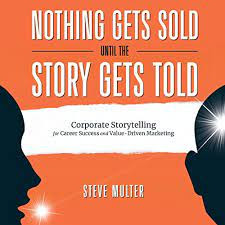
Nothing Gets Sold Until The Story Gets Told: Corporate Storytelling for Career Success and Value-Driven Marketing
by Steve Multer 
Message Master Media, 234 pages


If you’re in the marketing business, you know the difference between selling and telling.


But what if that difference isn’t what you thought?


You might think selling is what you want to do, and it requires a convincing pitch, versus telling, dismissed as just reciting facts and figures. “Show up and throw up.”


A new book turns that old wisdom around.


Selling is what you want to accomplish, but this new book says that telling – telling a story – is what closes the sale. In Nothing Get Sold Until the Story Gets Told, Steve Multer explains the role of storytelling in creating an effective message. It comes naturally for him because he tells stories for a living as a corporate presenter, spokesman, and public speaking trainer.

That’s right, a corporate presenter. It’s a perspective marketing and advertising people may not have considered, but Multer has a keen eye for all forms of marketing communication. Early in the book he describes an early form of content marketing -- from the 19th Century no less.


The Too Much Information Age


Much of the foundational thinking in the early chapters will ring true to marketers. The book describes in layman’s terms how our brains receive messages, categorizing them as no-value, low-value, medium-value, and high value. Very few messages make it to the high-value category, the ones that speak to us on a personal level first. Chapter 4 is a perspective in knowing your audience, which is the first rule of advertising. Chapters 5 and 6 are about clarifying your message. Successive chapters are about how to create and deliver the message.


This is not a trite book about public speaking, either. Multer debunks hackneyed advice like “open with a joke,” “tell a funny story,” or “shock your audience to gain their interest.” Those are tropes that don’t give your audience anything meaningful. (If we're honest, Super Bowl advertising has become a showcase for similar tropes that don’t give the audience anything meaningful.)


Passion is a word that comes up in the book frequently. That may not always be appropriate in an advertisement, but it is always appropriate in preparing an advertisement. You know how when you see a great ad, you know that the work has been loved by the people who made it? That’s passion showing through.


By the time you get to the chapter “From Corporate Speak to Human Conversation” you’ll see that this book really does apply to marketing and advertising, not just presentations. That said, we’re all presenters at some point in our work weeks. You’ll find a lot of solid advice for effective storytelling, including even how to make power point (and Zoom) work for you, not against you.


Coming back around to the title, we might agree that the best advertisements have always been the ones that tell stories. An ad that tells a story is always going to be more memorable. My two rules of effective advertising: (1) Impossible to describe the ad without mentioning the product. (2) Impossible to forget what brand created it. Stories make that possible.


Between each chapter is a short essay by someone who tells stories: an art historian, a musician, a documentarian, a playwright, a rabbi, an actor, others, and me. Yes, full disclosure, I contributed a page to this book, which naturally told a story about presenting an ad campaign to a client. Read my story here but look for Steve Multer’s book here

03 March 2021

My advertising strategy killed Dr. Seuss


As a newly-minted account executive at Leo Burnett, in a meeting with our clients at Keebler, my copy strategy presentation for Quangles multigrain chips was built around the well-known Dr. Seuss story, Green Eggs and Ham.  

The killer visual
This approach made sense at the time, because consumer research indicated that heavy snackers wouldn't love the idea of a multigrain chip. So we likened the challenge to Sam I Am convincing his target audience to eat Green Eggs and Ham.

Rather than write umpteen Power Point slides, most of my presentation was a dramatic reading of two or three passages from the book, and a single presentation board featuring the story's climactic moment. We passed around copies of the brief when I was done.

My boss at the time, Jeff Hiller, encouraged this approach and had me rehearse it a few times to maximize the effect. And what an effect it had.

We sold the strategy.

Then the next day, Dr. Seuss died.

Later that week, the client jokingly asked me not to feature him in future presentations.

I'm not sure if my advertising strategy killed Dr. Seuss, or if he's rolling in his grave this week, but he left a lasting legacy. Regardless of how you feel about Dr. Seuss Enterprises pulling six of his books, remember that his many other works - including Green Eggs and Ham - still have incredible value.

24 January 2021

How Short Should Ads Be?


Ads keep getting shorter, but not subliminal.

Way back in TV advertising history, there were 60-second ads. Some people still remember those; there was even an article in The Atlantic looking back on them, wistfully.

Ads used to be longer


Like most GenXers, I grew up with :30s and :15s on TV. Conventional wisdom, after I joined the industry but before bandwidth permitted online video, was to run :30s until awareness reached some level when :15s could take over as reminders or reinforcement.

Miller High Life ran 1-second ads in
the 2009 Super Bowl, featuring
the late, great Windell Middlebrooks
During my international career, I became familiar with :20s and even :10s. In Argentina, where I lived and worked for three years, ads could be any length client and agency wanted, because media time was bought and sold on a second-by-second basis. So, we made :17s, :36s, :52s, etc.

Maybe that Argentine flexibility is going global. 30-second units are still common on linear TV, but audiences can be reached on other platforms that allow for all sorts of possibilities. Bandwidth has improved and the shift to mobile devices and mobile-friendly formats, like YouTube and TikTok, permits shorter ads and new rules for what makes effective communication. The six-second format is common.

But does the six-second format work?

Shorter ads can work, but...


Magna Global, the IPG media research hub, has studied ad lengths across different video platforms. Their 2015 study found that even 5-second ads could build awareness, but it took :15s or :30s to drive brand favorability and purchase intent.

A lot changed in Magna's more recent study, just published in the last few weeks. This time, they found :06s and :15s to be similar in their ability to drive search intent, brand preference, and purchase intent. Why would that be?

One reason may be the platforms on which they ran the test: Snapchat, a video aggregator (i.e., YouTube) and a Full Episode Player (FEP, perhaps a streaming app like Hulu). Audiences are already accustomed to short ad lengths in these environments, and there were no :30s tested for comparison.

The Snapchat part of the test was interesting because more people watched :15s all the way through, but they were all placed mid-roll, about ten seconds into the content, so perhaps viewers were really staying for the content, which might explain the other finding that these ads were slightly less convincing.

YouTube was different. Viewers didn’t like the :15s, which were skippable after six seconds, but keep in mind that all of these were pre-roll ads, meaning that they were a barrier to the selected content. On the FEPs, :15s were better-received, but may also have been more expected during a 20-minute TV program.

None of these findings should surprise us, especially when you consider:
  • Linear TV wasn’t part of the test and neither were 30-second ads. It would be instructive to have these points of comparison.
  • The three viewing platforms in the test give individualized watching experiences, which may improve the ability of short copy to get across its messages, and also lead to less patience for longer ads.
  • We don’t know the quality of the ad creative shown. There were four brands included (Clinique, Mini, Lego and a “major CPG brand”) but we can only assume their ads were adequately memorable and persuasive.

On that last point, not only do we not know the quality of the ad creative, we don't know if it took full advantage of the format. Traditionally, :15s were (mostly) just shorter versions of :30s, both seen on linear TV. Newer formats, like a six-second pre-roll on YouTube, are seen by an individual person watching a very small screen. That calls for a different creative approach, and opens creative avenues instead of closing them.

It's always nice to have more time to get your message across, and :30s will continue to run on TV. But newer formats may prove to be a useful piece of your overall plan.

19 November 2020

Two rules of effective advertising


What makes effective advertising?

There are classic volumes and numerous listicles that purport to answer this question.  There are numerous research methods to pre-test advertising or measure it in-market.

Data only help us make well-informed decisions; data can't write copy for us.  Despite the advent of language-generating programs like GPT-3, data won't drive creativity, although it can (and perhaps should) help us formulate strategies.

How do I know if advertising is effective?


These are not rules for how to write effective advertising.  Every copywriter has rules and methods that work for them, as it should be.  Very few will consult a 12-point article when sitting down to create an advertisement and a 2-rule blog post would be no less presumptuous.  These are rules for the rest of us to keep in mind when writing a creative strategy or evaluating creative work.

Rule 1:  Impossible to tell someone about it without mentioning the product.


You know advertising is memorable when someone is willing and able to describe it.  The retelling will only be as accurate and complete as the ad's story was compelling.  But the retelling doesn't matter if the product isn't part of the story.

Two ads that make the product part of the story are Amazon's tale of two friends, a priest and an imam, who order the same gift for one another, both using Amazon's mobile app, and Metamucil's "The Regulars," in which three co-workers visit the restroom at the same time daily, due to the, uh, product benefit.  (This latter example also shows you what a product demo can be, as well as offering a pack shot that goes with the story.)

Rule 2:  Impossible to forget what brand created it.


You know advertising is persuasive when the recipient remembers the brand as well as the product. Common ways to improve the odds of success are a brand name linked to the product benefit (Chapstick, although they've let people use the name generically), a brand associated over the long-term with a clear positioning or benefit (Nike, athletic performance) or campaign elements consistent enough over time that they're easily recognizable (IBM, still using the blue letterbox treatment for almost 20 years).
Rule #2.

The two ads cited above follow this rule, too, mainly because the brand and product are so closely linked.

Be careful, however, because the degree of difficulty goes up if you're launching a new product that would take your brand into an adjacent category or even segment.

DO try this at home


Be a consumer.  Try this as you encounter advertising during the day, even/especially banner ads, billboards, any form of ad.  See if it's impossible for you to tell someone about the ad without mentioning the product, or impossible to forget what brand created it.

If you try this experiment at work -- well, be careful.  Look closely at messaging strategy and product portfolio.  Almost every time, advertising that breaks these rules came from business strategy that failed to consider them in the first place.

18 November 2020

What is Ad Majorem?

Thank you for visiting my blog, Ad Majorem.  When it started in the late 2000s, it was a view on modern marketing from within a large advertising agency.  Now it’s a view on modern marketing from the perspective of a CMO.

The title, Ad Majorem, is part of a familiar Latin phrase and loosely translates to English as “to the greater.”  As in, there is always an opportunity for better marketing: stronger consumer insights, more powerful ideas, channel-neutral marketing plans, and accountability so we know what sells and what doesn’t.


There’s also always an opportunity for better marketing people.  It’s important to me that team members keep learning as they go, staying curious and maintaining a perspective of continuous improvement.  We’re happier when we’re learning and growing, so that will continue to be a theme here.

The “ad” in Ad Majorem means all marketing communications, from social media to direct mail to Internet gaming to television commercials. To most consumer audiences all of these are advertising. My 
professional experience

in these channels provides a perspective that is part specialist, part generalist.

A lot has changed since 2009, not all of it “to the greater.”  We’re at a very inauspicious moment, with uncertainty, threats, deepfakes and divisions.  This blog has always avoided politics, and will continue to avoid politics, because there are too many wannabe pundits in marketing and advertising already.

That said, there’s always hope for the future, so the tone here will be hopeful as well as honest.  Don’t come here for dirt, fear or loathing. The closest I’ll come to that is self-criticism of the marketing business. Occasionally I’ll stray into a review of a campaign but only in service of a larger point.

Please comment. Otherwise this wouldn’t be an honest look at an industry where communication with consumers should be two-way, not just one-way.

One thing hasn’t changed since I started this blog.  Ad Majorem’s reason for being is to keep myself honest on embracing the challenges and changes of modern marketing. My hope is that you, too, will derive some professional growth from it.

04 May 2015

Chances Are You're Watching TV While Reading This Post


"Ninety percent of consumers are multitasking while watching TV.  On average, Millennials and Xers are doing three additional activities while watching TV, typically surfing the web, emailing, texting, or social networking."  -- Deloitte Digital Democracy Survey, fielded November 2014.

Source:  Deloitte Digital Democracy Survey
(Click to enlarge)

29 April 2015

Happy Twitterversary


Eight years ago today I tweeted for the first time.

To celebrate, Twitter lost 24% of its market value yesterday.

Twitter hatches

Although I didn't remember exactly what I tweeted that first time back in 2007, nor the exact date, I very clearly remembered the circumstances.  Twitter had suddenly taken SXSW by storm the month before.  I was on a business trip to Europe, reading an article about it in The Economist and decided to give it a try.

Signing up back then was very different:  You SMS'd to 40404 and by exchanging text messages you established a username and got started.  Coincidentally, just the other day I discovered a site that will find your first tweet.  I entered @SteveS1 and suddenly it all came back to me:

(Yes, I misspelled "coffee".  So sue me.)

Twitter lays an egg of its own

Yesterday afternoon Twitter's stock price was a fairly typical $51.19, but then their (somewhat) disappointing 1st quarter results came out prematurely and a day later shares are trading at $38.98.  That's about a 24% decline, not far from where it was on Day 1.

Is that bad?  Not really, for two reasons.

First, this news puts Twitter in proper company with the rest of the tech world, subject to the slings and arrows of outrageous fortune.  Just because Twitter is famous doesn't mean its stock won't go up or down.

Second, they're still racking up some impressive ad revenue, "only" $435.9 million in 1st quarter, which was 74% above the same quarter a year earlier.  Yes, it was a drop from the previous quarter, but their chief sin seems to have been missing financial analysts' expectations, which were more like $456.8 million.

The real question is whether this news represents a real weakness in ability to attract ad revenue.  Or as Twitter CEO Dick Costolo put it, the company had a "demand problem".  Here again, they're in proper company.  Many emerging media platforms have this problem, because advertisers aren't sure how or whether a new medium fits in their overall mix.

I'm not an investor in Twitter, so I can watch this play out with merely professional curiosity — what about you?  Any thoughts on the future of Twitter?

24 April 2015

Display Ads: the New Subliminal Advertising


In the days of Ye Olde Marketing there was a belief in "subliminal advertising" -- the idea that TV commercials would be spliced with fleeting images, usually sexual, to overpower your psyche and make you buy something you didn't need.

Although the science behind subliminal stimuli is interesting, it's never really been used in advertising and we have no examples of it ever working.  Most of the urban legend is based on a 1957 movie theater experiment that never actually happened.  

Comedian Steven Wright sent this up with one of his 1980s one-liners:  "I saw a Subliminal Advertising executive….but only for a second."

Online Display is the New Subliminal Advertising

This all came to mind when reading the Internet Advertising Bureau's latest viewability standards:  "Desktop display ads to be considered viewable if 50% of their pixels are in view for a minimum of one second."

Banner ad?
I didn't see any
banner ad.
50% of the ad for just one second.  We used to call that subliminal advertising.

In a not very subliminal display of honesty, the IAB press release on this topic is headlined "100% Viewability Measurement Is Not Yet Possible".


It's Like We Never Noticed This Before

How did we get to this point?

The Internet didn't used to allow advertising at all, banning it until 1991.  The first form of advertising was actually email — yes, direct mail — which as we all know spawned spam.  The first clickable display ad came in 1993, and in 1994 Wired started selling banner ads to clients like AT&T, with a click-through rate of 44% (no, that's not a typo, and we should point out that the click bait was an online tour of seven of the world's most acclaimed art museums).

These initial approaches revealed a direct-response mindset, and unrealistic expectations as to how perfectly measurable advertising would be on the Internet.  Not quite!  As click-through rates have dropped to infinitesimal numbers, online display has gone from marketing's Holy Grail to just billboards posted on the Information Superhighway.  Today's tools don't consistently measure page takeovers, road blocks and other customized placements.  As IAB president Randall Rothenberg said, "Different ad units, browsers, ad placements, vendors and measurement methodologies yield wildly different viewability numbers."  If you were expecting an accounting exercise that neatly reconciled everything, we don't have one.

The goal is "100% viewability" and at some point we'll get there.  In the meantime there will be some tough discussions among advertisers, agencies, media and researchers.  

Meanwhile, the irony is that an urban legend from 1957 is reality in 2015.

24 March 2015

Ad Spending: Pixels are Up, Ink & Paper are Down


U.S. ad spending went up slightly in 2014 because pixels increased more than ink & paper declined.

That's my analysis of fresh data from Kantar Media summarized in this chart:


The pixels were TV (+5.5%) and Internet Display (+0.9%).  Representing ink & paper were Magazines (-5.1%), Newspapers (-10%), Outdoor (-0.2%) and FSIs (-2.8%).  Radio was also down -3.9%.

Like everything in modern media, though, it's never this simple.

Two Questions to Think About

Please consider the environment
before printing this billboard
The "pixels" category above only seems to represent the "First Screen" (TV) and the "Second Screen" (personal computers).  We don't see the Third Screen (mobile devices) and Fourth Screen (digital out of home).  That leaves us with a couple of questions.

What is TV?  As posted recently, TV isn't dead, it's just morphing into a more personalized experience.  If anything is dying, it's Cable TV.  Now, Cable ad spend actually grew +6.8% last year, a big reason for TV growing +5.5% overall, thanks to sports and political campaigns.  But viewers are cutting the cord, or at least shaving it, in favor of new OTT options.  The thing is, it's harder to track the ad revenue, which is there if you're watching The Flash online at CWtv.com, but not if you're watching House of Cards on Netflix.  Kantar says their data doesn't track online and mobile video ad spend.

What is Outdoor?  The vast majority of OOH (Out of Home) inventory is still ink & paper, although many media companies continue investing in DOOH (Digital Out of Home) and Digital Place-based Media.  Kantar pointed out "digital outdoor ad spending has grown six times faster than the overall medium".  So it's reasonable to say that Outdoor's -0.2% decline is probably a mix of pixels being up and ink & paper being down.

31 January 2015

The State of TV Advertising on the Eve of the Super Bowl


The Super Bowl has always symbolized the power of TV advertising.  Is that power waning?

Many business journalists seem to think the Super Bowl is the last bastion of TV advertising.  Just this morning as I was writing this post, The Economist daily news digest arrived, calling the Super Bowl "something increasingly rare in television: a programme that people watch live and in large numbers."

Surprise! Most TV Viewing is Still Done on a TV

Now let me explain
"Programmatic" to you
Actually, Live TV viewing is holding steady at about 4-1/2 hours per day.  Yes, 66.8% of Broadband Users Under 35 watch TV on a combination of these devices, but for all age groups most TV viewing is still done on a TV.  

This will shock Upper West Siders who binge-watch Orange Is The New Black on Netflix.  But regular people are watching live sports, NCIS, Dancing With The Stars, American Idol, Judge Judy and Big Bang Theory.  Bazinga!  

But Fragmentation Will Continue

TV was never dying; it was just following audiences to new platforms.  Cable supplanted Broadcast and new devices emerged like DVRs, OTT, Online and Mobile.  There will always be big audiences, but they will continue fragmenting.  In Ye Olde Marketing buying and selling TV was relatively straightforward and audience delivery was measured by Nielsen.  But now audiences are fragmented and sometimes not even measured.  Only Netflix knows how big the audience for Orange or House of Cards really is.  (A Los Angeles Times reporter tried thinking it through.)

The Super Bowl doesn't have this problem.  The marquee advertising will air during NBC's broadcast, and people will see it on TVs, tablets and other places.  The audiences will be big enough that few advertisers will worry about under-delivery against their $4.5 million (unless they're spending that money in the 4th quarter of a one-sided blowout).

The Revolution May Not Be Televised, but TV Will Be Personalized

But even in a big event that almost everyone watches or knows about, we see the future of TV:  Personalization.  For the Super Bowl it takes the form of second- and third-screen programming, i.e. game analysis, ad analysis and social media traffic.  Little of this is driven from broadcaster to audience; it's more of a conversation where both participate.  The famous Oreo dunk-in-the-dark tweet generated very small response:  15,000 Retweets and 20,000 Likes.  (In fact they probably generated more blog posts than that, but I digress.)  But it's OK because they learned how be part of people's conversations.  

In the same way, Oreo's latest stunt -- yes, it's a stunt -- using programmatic methods to buy a :15 in the Erie (Pennsylvania) DMA is a harbinger of things to come.  "Programmatic" is one of those words that's taken on too many meanings, but it's generally associated with media buying, just like the online ad world from which it came.  Its real value will be as a pathway to addressable TV, a way for audiences to customize the programs they see -- and advertisers to customize the messages that make them possible.

Enjoy the game -- and the ads -- and know that you'll always have plenty of company watching that first screen.  Keep one eye on those other screens, too, because they're a window to the future.

01 November 2014

Automatic Advertising: We Take Spotomate for a Test Drive


Software can make your 30-second TV commercial.

You knew this would happen.  Not just because technology makes the software possible, but because newly-available media makes it necessary.

There's the first screen (TV), second screen (computer), third screen (mobile), fourth screen (digital signage) and all of them are hungry for content -- and advertising.

Technology has been busy democratizing the science of advertising.  Small business is able to do SEO, SEM and Social Media without an agency, as did my friend the garage door expert.  So why not video advertising creative?

Along comes Spotomate, which via its partner Shakr, offers a service allowing small- and medium-sized businesses to make "your own agency-quality video advertising spots".  They're targeting operators of digital signage networks (see industry coverage here and here), but I decided to experiment with it myself during a free trial open until Thursday.

Voilà… Ad Majorem's First Ads

How it works:  You pick one of their pre-set templates, it runs you through the places where you must write copy or provide a visual asset, and automatically sequences these with graphics and a music bed.  So here were two attempts using our masthead copy and experimenting with different visuals.


Here's What I Thought About Spotomate

Agencies, for the most part, shouldn't worry.  True, I did once have a colleague who believed in "campaign construction", i.e., every 30-second TV commercial for a brand had to have the same sequence of scenes, but most big advertisers want customized treatment.

Small- and Medium-sized businesses will love Spotomate, though.  In fact the templates may help inexperienced advertisers to organize their thoughts and force decisions as to what should or shouldn't go in the ad.

In other words, one still needs a smart brief, and I'm not sure that will ever be automatic.

What do you think of Spotomate?  What did you think of my, uh, "ads"?  Go ahead, hit me with your best shot in the comments section below.

16 September 2014

Why Signage Is a Modern Medium


Advertising may or may not be the second-oldest profession, but signage is surely its first-oldest form.  It all started with signage.

The History of Signage

It all continued with signage, too — literally for centuries.  Sure, the production of signs evolved from stone cutting to wood cutting to paint to ink and paper and eventually electric signs, but it was all the same thing:  a one-way message from advertiser to consumer.  Even if you check Wikipedia's definition of signs, that's about as far as it goes.


Signage Suddenly Evolved

Suddenly, in the past decade or so, signage evolved.  Screen technology made signage digitized, scalable and interactive.  After centuries of signs that featured only one-way messages, suddenly signs were really screens that offer two-way communications:  advertiser to consumer and vice versa.  As these technologies developed, signage became a way for consumers to reach advertisers.

Back to the Future

Blade Runner and Minority Report both had futuristic signage technology, but Blade Runner was made in 1982 when advertising still had a (mostly) one-way mentality (advertiser-to-audience), while Minority Report, made in 2004, featured interactive ads, probably because the advertising business had already started becoming interactive.  Similarly, this past year at Cannes there was a Grand Lion for Innovation awarded to an interactive billboard at Sochi.  Passers-by could take photos with their smartphones and project them as a 3-D image on the billboard.

Why Signage is a Modern Medium

Signage is not only ubiquitous, it's been modernized.  Here are some tips to make the most of it:
  • Elicit an immediate response.  In many cases it's sufficient to remind people to drink Diet Coke or tune in to tonight's reality TV show. But why stop at awareness?  If your message is compelling enough, the audience will respond to you via SMS, toll-free call, mobile Web, social media or an app download.  But you have to offer something useful, informative or entertaining.
  • Make it relevant.  Screens give signage the ability to increase relevance to the consumer.  The most basic example would be to rotate messages according to the time of day (a QSR client advertises breakfast until 9 a.m., switching to lunch messages after that), which isn't possible with ink and paper.  You can also place messages according to where the screen is located, e.g., in an elevator or a doctor's office waiting room.
  • Plan ahead.  Screens make signage flexible, but paradoxically that requires advance planning, not the least of which might be convincing a client to try something new and taking the time to develop creative that's relevant and elicits an immediate response.  Once you have a game plan, you're much more prepared to make adjustments.


02 May 2014

Book Review: Creativity, Inc.


Creativity, Inc.: Overcoming the Unseen Forces That Stand in the Way of True Inspiration
By Ed Catmull
Random House, 340 pages

I hate business books because they are usually very long memos that could have been written in 14 pages.  You suspect they started as memos or even power point slides.

I love books that tell good stories.  Creativity, Inc., by Pixar co-founder Ed Catmull, tells a good story and in the process teaches us a lot about how to tell a good story.

Not Just a Story about Toys

Ed Catmull was a kid with a dream, to produce animated movies using computer technology.  He wanted to work at Walt Disney.  They turned him down at first, but he kept on following his passions. 

Catmull’s path led through some interesting places and people.  He studied computer technology at University of Utah, one of the four original institutions on ARPANET, the precursor to what we now know as the Internet.  His early, groundbreaking computer animation work led to a job offer from George Lucas.  While at Lucasfilm, Catmull hired Pixar’s other co-founder, the animator John Lasseter, and what they built was spun off to Steve Jobs in 1985.  The new company’s main business was selling the Pixar Image Computer.  They were in the hardware business. 

As we all know, they eventually joined forces with Disney and became the animation studio that produced Toy Story and many hit films since.  Like those films, the book tells compelling stories.  Inner-circle, name-dropping – jaw dropping – stories of how these hit films made it through the creative process and the business process. 

And as this story unfolds, you see Catmull evolve from a technologist to the head of one of the most creative organizations ever built.  Every chapter illustrates a Pixar mantra, “Story Is King.”

Trust the Process.  Not!

Pixar had another mantra, “Trust the Process”, which meant Pixar’s process, very different from the corporate one at most Hollywood studios:  “Pixar was a place that gave artists running room, that gave directors control, that trusted its people to solve problems.”  To me, this sounded more like “Trust the Culture”, not “Trust the Process”, but it seemed to work for Pixar.

Indeed, it served them well making Toy Story, but not so well when simultaneously working on A Bug’s Life and Toy Story 2.  They had grown.  Suddenly more people were involved and Catmull and Lasseter were pulled in different directions.  The mantra lost meaning; it “morphed into ‘Assume that the Process Will Fix Things for Us’.”  Unfortunately, Toy Story 2 lost meaning, too, and they realized they had to rewrite it just nine months before theatrical release.

What did they learn from that experience?  The process only works if the people are working well together, and while that was Pixar’s biggest superpower, they weren’t using it at this critical, early stage of their maturation as a company.  They got back on track by establishing a “Braintrust” that regularly reviewed how a story – a film – was coming together.  They didn’t go back to Process so much as they went back to Culture.

They also learned that words can be empty.  “People glom onto words and stories that are often just stand-ins for real action and meaning,” he writes.  Tellingly, he uses this occasion to criticize our industry:  “Advertisers look for words that imply a product’s value and use that as a substitute for value itself.”  Ouch.

So is process good or bad?  When we think of “process” in Ad Land, it’s often a linear, stage-driven timeline, which isn’t how creativity really works.  You need a process, of course, because the alternative is chaos, but how to let it roll?  The Toy Story 2 experience taught them how to strike a balance by returning to their natural strength in collaboration.  It makes sense to “trust people to solve problems” when they’re doing it in a group, not in separate silos.

Three Lessons Advertising, Inc. Can Learn from Creativity, Inc.

Although this book can teach a few things to any creative enterprise, here are three lessons for Ad Land.
  • Story trumps Technology.  Catmull’s childhood dream wasn’t to bring new technology to animation; it was to make animated movies using technology.  Everything he invented was in service of telling the story.  His biggest satisfaction in the success of Toy Story was how audiences and critics loved the story so much they barely mentioned the use of computers to tell it. 
  • Feedback diagnoses, not prescribes.  You’ll appreciate the many vignettes of Pixar’s “Braintrust” meetings to discuss films in development.  They built such a strong culture of mutual respect and focus on the work that every session was about what to address – not how to address it.  (In the last chapter, “Notes Day”, we see how this culture improved the company as a whole.)  In contrast, they discovered that Disney’s Michael Eisner didn’t even discuss; he just issued lists of “mandatory notes”.
  • People create Ideas.  This sounds obvious but Catmull points out that many leaders confuse the need for Great Ideas with the need for Great People.  He concludes:  “Getting the team right is the necessary precursor to getting the ideas right.”  (This reminded me of the only business book I ever liked, Good to Great, which made exactly the same point in its first chapter.)

Which brings us to Steve Jobs, the deus ex machina in this story.  Jobs was smart enough not to push his way into scripts, storyboards and edits, though he certainly had that right.  He invested heavily in Pixar – and he believed in it and he stayed loyal to it.  Catmull mentions Steve when he’s relevant to the story, and that was often enough that I planned to mention it in this review.  Then I got to the end of the book, and saw Afterword: The Steve We Knew.  It’s a beautiful tribute to Jobs and an appraisal of his impact on Pixar.

Read this book, people.  At minimum it’s a good story you won’t want to put down.  But it also teaches us a lot about how advertising people can work together and tell a good story.