Showing posts with label Book Review. Show all posts

04 March 2023

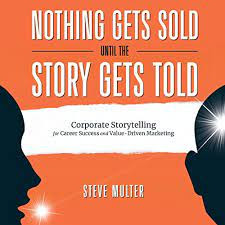
Book Review: Nothing Gets Sold Until The Story Gets Told

Nothing Gets Sold Until The Story Gets Told: Corporate Storytelling for Career Success and Value-Driven Marketing
by Steve Multer 
Message Master Media, 234 pages


If you’re in the marketing business, you know the difference between selling and telling.


But what if that difference isn’t what you thought?


You might think selling is what you want to do, and it requires a convincing pitch, versus telling, dismissed as just reciting facts and figures. “Show up and throw up.”


A new book turns that old wisdom around.


Selling is what you want to accomplish, but this new book says that telling – telling a story – is what closes the sale. In Nothing Get Sold Until the Story Gets Told, Steve Multer explains the role of storytelling in creating an effective message. It comes naturally for him because he tells stories for a living as a corporate presenter, spokesman, and public speaking trainer.

That’s right, a corporate presenter. It’s a perspective marketing and advertising people may not have considered, but Multer has a keen eye for all forms of marketing communication. Early in the book he describes an early form of content marketing -- from the 19th Century no less.


The Too Much Information Age


Much of the foundational thinking in the early chapters will ring true to marketers. The book describes in layman’s terms how our brains receive messages, categorizing them as no-value, low-value, medium-value, and high value. Very few messages make it to the high-value category, the ones that speak to us on a personal level first. Chapter 4 is a perspective in knowing your audience, which is the first rule of advertising. Chapters 5 and 6 are about clarifying your message. Successive chapters are about how to create and deliver the message.


This is not a trite book about public speaking, either. Multer debunks hackneyed advice like “open with a joke,” “tell a funny story,” or “shock your audience to gain their interest.” Those are tropes that don’t give your audience anything meaningful. (If we're honest, Super Bowl advertising has become a showcase for similar tropes that don’t give the audience anything meaningful.)


Passion is a word that comes up in the book frequently. That may not always be appropriate in an advertisement, but it is always appropriate in preparing an advertisement. You know how when you see a great ad, you know that the work has been loved by the people who made it? That’s passion showing through.


By the time you get to the chapter “From Corporate Speak to Human Conversation” you’ll see that this book really does apply to marketing and advertising, not just presentations. That said, we’re all presenters at some point in our work weeks. You’ll find a lot of solid advice for effective storytelling, including even how to make power point (and Zoom) work for you, not against you.


Coming back around to the title, we might agree that the best advertisements have always been the ones that tell stories. An ad that tells a story is always going to be more memorable. My two rules of effective advertising: (1) Impossible to describe the ad without mentioning the product. (2) Impossible to forget what brand created it. Stories make that possible.


Between each chapter is a short essay by someone who tells stories: an art historian, a musician, a documentarian, a playwright, a rabbi, an actor, others, and me. Yes, full disclosure, I contributed a page to this book, which naturally told a story about presenting an ad campaign to a client. Read my story here but look for Steve Multer’s book here. 

23 March 2021

Book Review: Working Backwards by Colin Bryar and Bill Carr

Working Backwards: Insights, Stories, and Secrets from Inside Amazon
By Colin Bryar and Bill Carr
St. Martin's Press, 304 pages


"You, too, can build a business behemoth - just like Jeff Bezos - by following the proven method of Working Backwards!"

Colin Bryar and Bill Carr don't come right out and make that promise, but their book Working Backwards openly invites you to adopt Amazon's business methods. They both left Amazon years ago, but "can't imagine doing business without (these principles)." Given their success, you can understand their enthusiasm - and perhaps your own curiosity about what made Amazon so successful.

Working Backwards: Book Summary


The first half of the book, "Being Amazonian," lists the elements of their corporate culture: leadership principles, hiring process, organizational design, prose narratives vs. PowerPoint, consumer focus, and managing inputs vs. outputs. The second half of the book tells stories of how these principles led to successful product launches: Kindle, Amazon Prime, Prime Video and AWS.


Despite how neatly the book summarizes all of the lessons, there's a real-life messiness to the narrative because Amazon admits failures on the road to success, and the authors are honest about those journeys.

This review focuses on two elements of their corporate culture, communication in prose, and the consumer focus.

Communicating: Narratives and the Six-Pager


My whole reason for reading the book in the first place was a sense of vindication about the superiority of memo-writing, especially over PowerPoint.

You may have heard that Amazon banned PowerPoint in favor of six-page memos, or "narratives" that present the meeting material in one cogent, organized document. The authors describe how the company realized PowerPoint may enable a great presentation but it rarely catalyzed insightful discussion. In a memo to employees, Bezos said "a good memo forces better thought and better understanding of what's more important than what, and how things are related." PowerPoint, he added, "gives permission to gloss over ideas, flatten out any sense of relative importance, and ignore the interconnectedness of ideas." Hear, hear!

How this works in practice: there is "an eerie silence at the beginning of Amazon meetings" while those assembled take 20 minutes to read the memo. (Don't you love the idea of not having to do the homework before showing up at the meeting?) The authors describe the company's reaction to the PowerPoint ban, and difficulty in changing to the six-page memo, but they stuck to it and now it's enshrined in this book as a principle. They even wrote, within the book, a six-page memo about how to write six-page memos.

Working Backwards: Start with the Desired Customer Experience


Every marketing thought leader, guru, Twitterati, and conference speaker has always spouted some version of the wisdom that innovation must start with the desired customer experience. In this book you can read about how to do it vs. just hearing yet another sermon about it. PR pros will delight at the idea that new product innovation at Amazon begins with the writing of a press release, a document they call PR/FAQ. This is akin to writing a new product concept for BASES forecasting, but the example they give on page 109 starts with an amazingly clear first paragraph that's better than most new product concepts I've seen in my career. Just like the six-page memo, this press release with FAQs focuses the team's thinking.

The rest of the chapter describes in Amazonian terms how they think through the market opportunity, source of volume, economics, P&L, external partners, and feasibility hurdles. You will nod your head at all of these steps, but the news here is how, having started with the customer experience in mind, they never lose sight of it amidst the numbers and analysis.

Something from an earlier chapter explains how Amazon organizes for innovation. You've probably heard of Amazon's "two-pizza rule," referring to the number of people who can be fed by two pizzas. Often described as a limit on the number of people in a meeting, it's actually the number of people allowed on a product development team. The authors explain that they tried this concept in other functional areas but it only proved necessary for speedier product development.

Yes, I recommend this book


A friend once observed that most business books can be written as 14 PowerPoint slides, i.e., most business books are not as analytical and insightful as 300 pages would suggest. That's not the case here. After one of the most serviceable book introductions I've ever read, each chapter reads quickly and clearly. All that practice writing six-page memos instead of PowerPoint decks obviously helped.

22 November 2020

Book Review: If Then by Jill Lepore

If Then: How the Simulmatics Corporation Invented the Future
By Jill Lepore
Liveright Publishing, 432 pages

The guys who invented predictive analytics never saw failure coming.

That’s the upshot of Jill Lepore’s latest book, If Then: How the Simulmatics Corporation Invented the Future. 


Ostensibly, it’s the story of Simulmatics, founded in 1959 on the idea that with enough data collected in one place, everything and everyone would become predictable. The name is an attempted portmanteau combining the words “simulation” and “automatic.” You’ve probably never heard of Simulmatics because it folded in 1970, but during its short history it played a role in electing John F. Kennedy, mismanaging the Vietnam War, seeking answers to 1960s social upheaval, and speeding the presence of mainframe computers at advertising agencies.


If Then: Book Summary


The founder of Simulmatics was Ed Greenfield, a midcentury ad man, but not like Don Draper. Lepore delightfully introduces him: “He was like a ten-million-volt Looney Tunes electric magnet, a giant red-handled iron U that pulled everyone toward him.” His personality, his ability to influence others, was what propelled him. As evidence, the story includes a lot of bold-faced names, especially from Democratic Party politics, which is what Greenfield cared about most.


Indeed, he built an impressive team. Lepore introduces the other main players early, and efficiently. Harold Laswell, the influential communications theorist. Eugene Burdick, novelist and self-styled adventurer. Alex Bernstein, mathematician and computer programming pioneer. Ithiel de Sola Pool, a social scientist specializing in technology. Bill McPhee, a FORTRAN programmer – and this is such an emblematic aspect of the story – who wrote “the core intellectual property” of Simulmatics while he was committed to Bellevue. Yes, a mental hospital.

Punchcards
on parade


Like any startup, the group had big plans. They bragged they had invented “the A-bomb of the social sciences.” They called it a “People Machine” that could predict the outcomes of advertising campaigns and government policy initiatives. Sadly, they couldn’t get out of their own way. They overplayed their true role in JFK’s winning presidential campaign of 1960. They overpromised how they could help the New York Times analyze the 1962 midterm elections in real time. They overestimated, tragically, how Western-style social science techniques could understand Vietnamese culture. They oversold their value to blue chip brands but opened the door to a legion of market research providers still selling soap today.


One gap in the story: What projects did they actually finish? The only projects fully described were the political ones, and there was only fleeting mention of having sold studies to various corporations, like Bristol Laboratories, Philip Morris, P&G, and some others. Simulmatics was always starved for data, so most of the projects had little effect. Still, it would have been interesting to read more about those episodes.


Eventually Simulmatics folded, although some of its work survived in projects undertaken by individual team members, thus laying the groundwork for today’s data-driven marketing. They accomplished just enough to push things forward, but not enough to get pinned with credit or blame for what we have now. Oddly, Simulmatics’ most accurate predictions came not from data but from the very human insights of Ithiel de Sola Pool. He envisioned with eerie accuracy the role of technology in our lives today: the interconnectedness of the World Wide Web, the ubiquity of social media, and the rise of “mobile computers,” today’s smartphones.


Why Simulmatics matters now


Lepore’s book is thoroughly researched and well-written. It’s a solid history, which is why Simulmatics matters: because we learn from history. Here’s what I took away:

  • No data. It shouldn’t have been surprising, but was nevertheless shocking, how Simulmatics never seemed to have data that were complete or accurate. In an almost poignant moment, Lepore writes, “Pool raised the question that Simulmatics would never really answer: ‘What is the data we would need for this model?’” Ad agencies, which had data, filled the gap, bringing in their own IBM mainframes and offering the services to clients directly. Today we have plenty of data, but we still have to answer the question: Which data do we need to solve this problem?
  • No humility. The Vietnam phase of the book is a troubling read. Defense Secretary Robert McNamara in 1962: “Every quantitative measurement we have shows we are winning the war.” That might have been all too true; Lepore points out that military progress was measured by “the number of insurgents killed,” with the implication that indiscriminate killing ran up the numbers. Humility is a function of introspection. Are we thinking things through? Are we seeing the big picture? Are tracking the right metrics? These questions are relevant to the work we do today.
  • No humanity. Lepore points out that computers can simulate a flight because physical laws like F=ma are constant. “But the computer simulation of human behavior … is much more difficult. Behavior is not a law.” If, as some Artificial Intelligence experts say, the brain is just a very sophisticated machine, then eventually we will create a machine that can think like a human brain. But there is a (so far) unquantified human element that no series of If-Then scenarios in FORTRAN, C++ or Python could ever predict.

Simulmatics failed where other succeeded. There’s still lots of room for modern failure, which is why these lessons from the past are important.